

Minnesota Deferred Compensation Plan (MNDCP)
What Is the Minnesota Deferred Compensation Plan?
The Minnesota Deferred Compensation Plan is a voluntary governmental 457(b) retirement savings plan.
It is available to eligible full-time, part-time and temporary Minnesota public employees, including people employed by the state, cities, counties, townships and school districts. Contributions are generally made through automatic payroll deductions, and participants choose how their account is invested from the available plan options.
Unlike a pension, your MNDCP benefit is not based on a formula using your salary and years of service. The amount available to you depends on:
- How much is contributed
- Whether your employer provides a match
- How the money is invested
- Investment performance
- Fees and expenses
- The withdrawals you eventually take
That means your pension and MNDCP can play different roles.
Your pension may provide a recurring monthly benefit. Your MNDCP account can provide more flexible access for healthcare, larger expenses, tax planning, travel, home improvements or income before Social Security begins.
MNDCP is not the same as MSRS
MNDCP is administered through the Minnesota State Retirement System, but it is not limited to state employees and it is not itself an MSRS pension.
Depending on your public employer, you may have:
- A PERA pension and MNDCP
- A TRA pension and MNDCP
- An MSRS pension and MNDCP
- MNDCP without a traditional Minnesota public pension
- A spouse with an entirely different retirement system
The planning involves understanding what each benefit is designed to do.
Why Is a Governmental 457(b) Different From a 401(k), 403(b) or IRA?
A governmental 457(b) has several features that can be especially useful to Minnesota public employees.
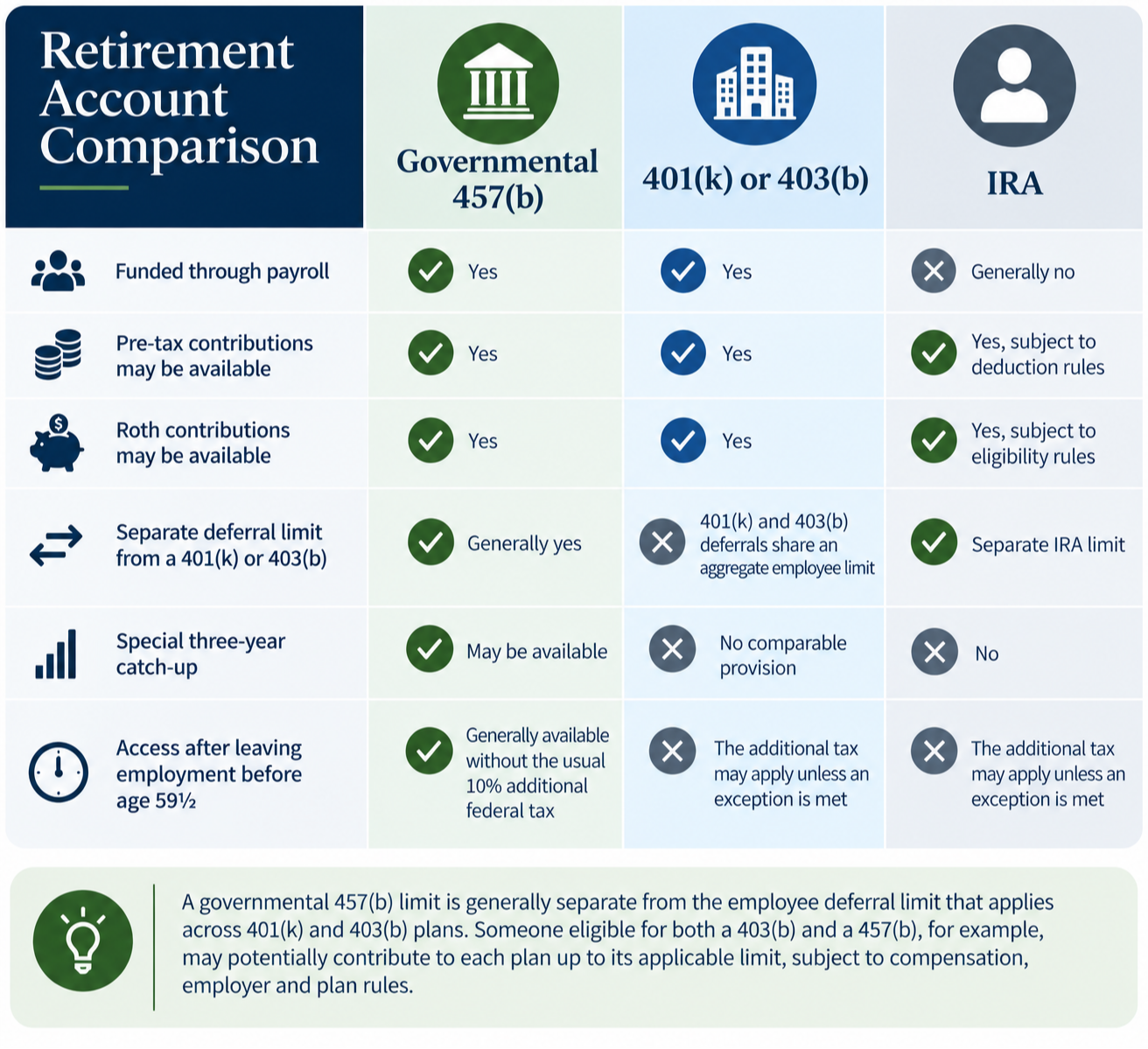
That can be particularly valuable for:
- Educators with access to both a 403(b) and 457(b)
- Healthcare professionals with multiple workplace plans
- Higher-income public employees trying to save more during their final working years
- Employees who started saving later in their careers
- First responders preparing for retirement at a younger age
The ability to contribute more does not automatically mean you should maximize every account. Contributions still need to fit your cash flow, tax situation, retirement date and household priorities.
How Much Can You Contribute to MNDCP in 2026?
The following MNDCP contribution limits apply for 2026:
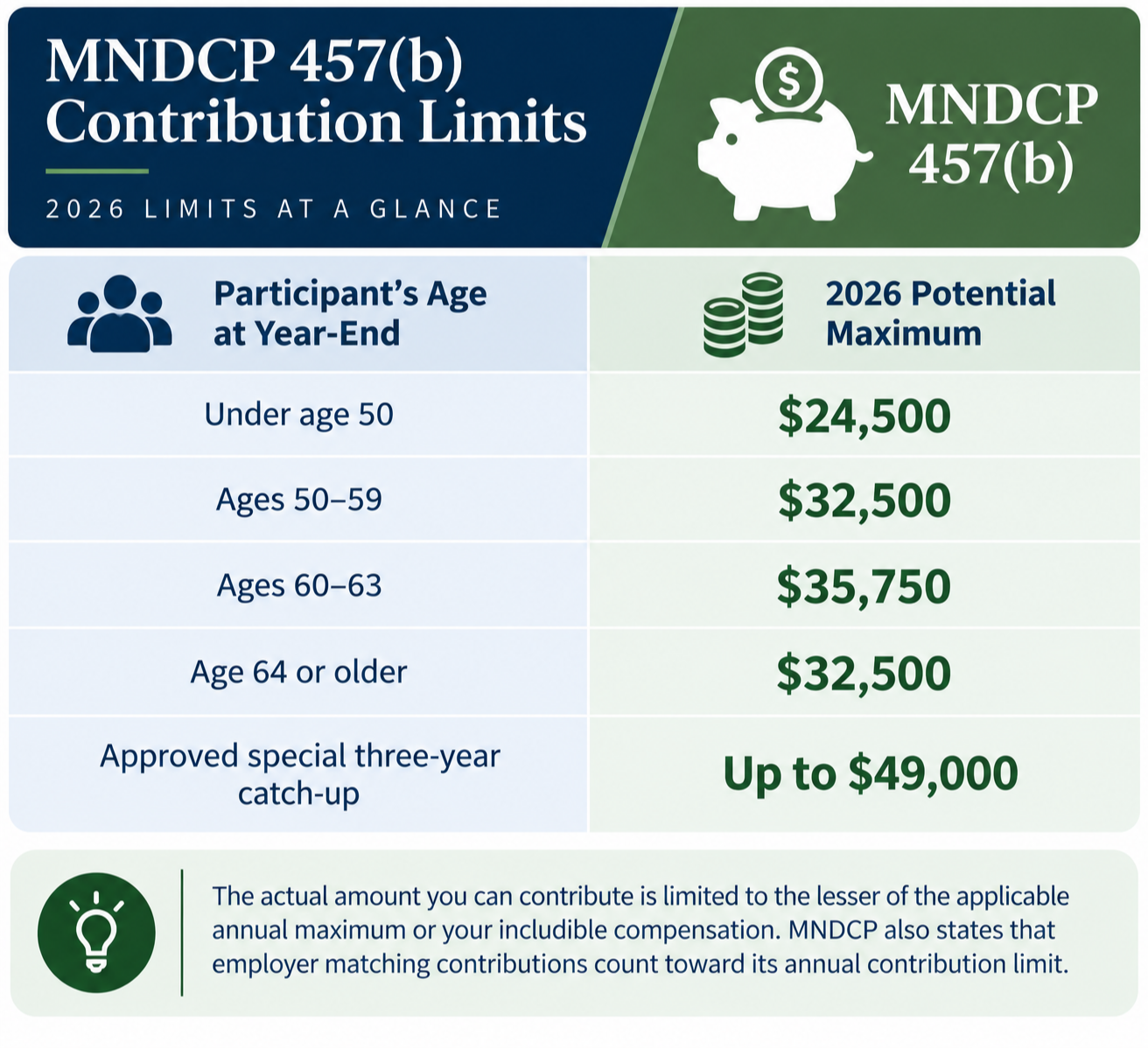
An important 2026 Roth catch-up rule
Beginning in 2026, certain participants whose prior-year Social Security wages—reported in Box 3 of Form W-2—were more than $150,000 must make their age-based catch-up contributions as Roth after-tax contributions.
This generally affects contributions above the regular $24,500 limit. It does not necessarily require the participant’s entire MNDCP contribution to be Roth.
The $150,000 test is based on prior-year FICA wages from the employer sponsoring the plan, not necessarily total household income or even total gross compensation. The threshold is subject to future inflation adjustments.
The special three-year 457(b) catch-up is treated differently and may still permit pre-tax contributions, subject to plan approval and the participant’s available catch-up amount.
Pre-Tax or Roth MNDCP: Which May Make Sense?
MNDCP permits eligible employees to direct contributions to pre-tax savings, Roth after-tax savings or a combination of both.
The right choice is not determined by age alone.
It depends on when you expect to pay taxes and how much flexibility you want in retirement.
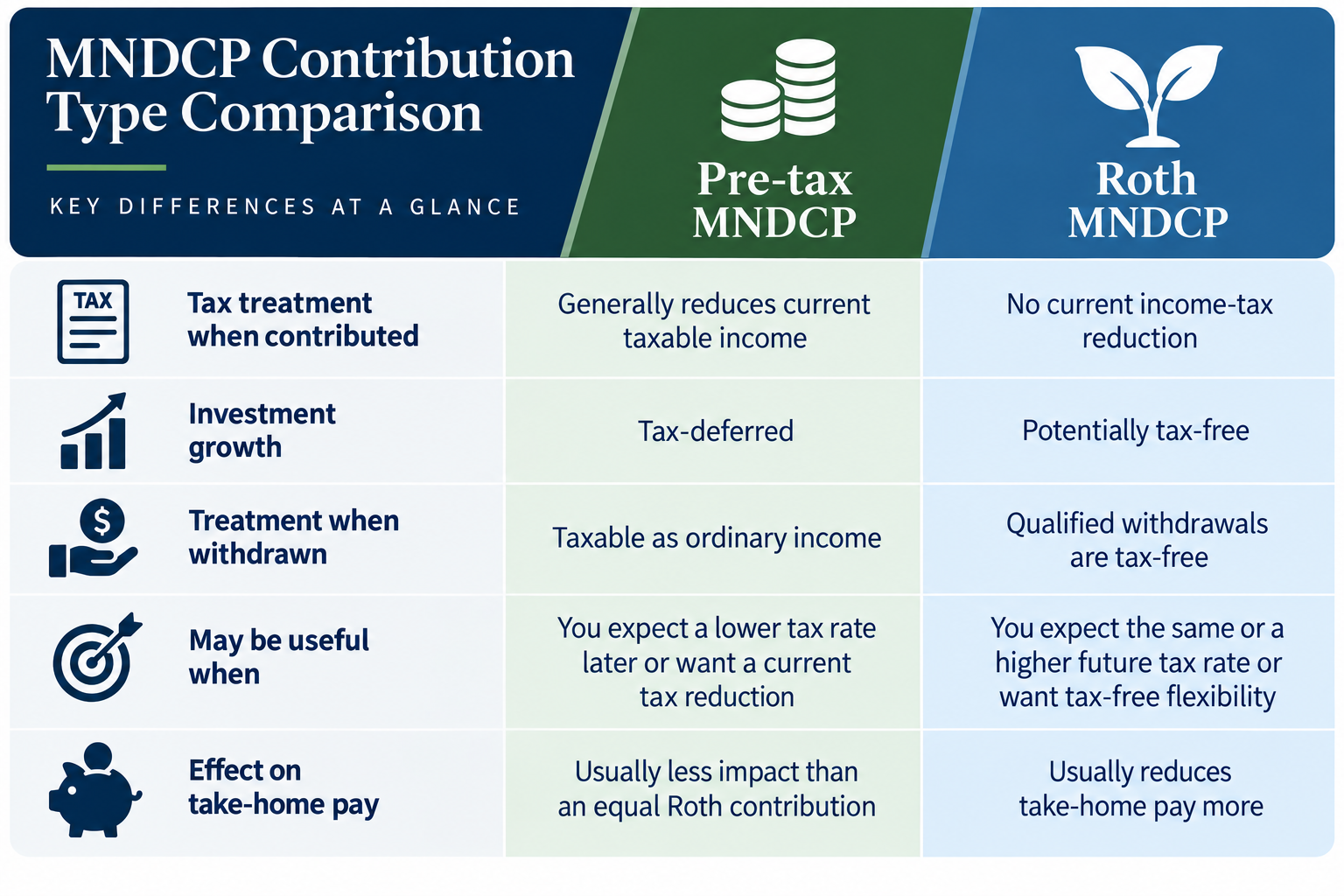
MNDCP explains that pre-tax contributions reduce current taxable income, while Roth contributions are made after taxes. Roth earnings can be withdrawn tax-free when the distribution is qualified.
For an MNDCP Roth distribution to be fully qualified, the Roth account generally must have satisfied a five-taxable-year participation period, and the withdrawal must occur after age 59½, following disability or after the participant’s death. A withdrawal that does not meet those requirements may cause the earnings portion to be taxable even though the original Roth contributions have already been taxed.
Questions to consider
Pre-tax contributions may deserve more consideration when:
- You are in a higher tax bracket today
- You expect taxable income to fall after retiring
- Reducing current taxable income is a priority
- You need to preserve more take-home pay
- You expect to have lower-income years available for future Roth conversion
Roth contributions may deserve more consideration when:
- You are currently in a relatively low tax bracket
- You expect significant pension income throughout retirement
- You want a source of potentially tax-free retirement funds
- You want flexibility for larger one-time expenses
- You already have substantial pre-tax pension and retirement-account income
Many public employees do not need to choose only one. A combination of pre-tax and Roth savings may provide more flexibility when creating a future withdrawal strategy.
Why a 457(b) Can Be Useful When Retiring Before Age 59½
One of MNDCP’s most valuable features is the ability to access the account after leaving public employment without automatically triggering the federal 10% additional tax commonly associated with early retirement-account distributions.
MNDCP generally allows participants to access their savings at any age beginning 30 days after terminating employment. It also permits withdrawals after age 59½ even when the participant remains employed.
The IRS generally does not apply the 10% early-distribution tax to distributions from an eligible governmental 457(b) plan. Pre-tax withdrawals are still generally included in taxable income.
That can make MNDCP especially useful for someone who:
- Retires from public service in their 50s
- Needs to bridge several years before Medicare
- Wants to delay Social Security
- Has a pension that does not fully cover monthly expenses
- Needs income before another retirement account becomes easily accessible
- Wants to avoid committing to a permanent pension or Social Security decision too early
Important rollover exception
The early-access advantage may not apply the same way to money previously rolled into MNDCP from an IRA, 401(k), 403(b) or another qualified plan. The IRS states that distributions attributable to certain rolled-in qualified-plan or IRA amounts may remain subject to the 10% additional tax.
Source tracking and rollover history can therefore matter.
Similarly, moving MNDCP money into an IRA before age 59½ may change the early-withdrawal rules that apply to future distributions.
A rollover decision should be based on more than account consolidation.
How Does the Special Three-Year 457(b) Catch-Up Work?
MNDCP has a special catch-up provision for eligible participants who are within three years of the plan’s normal retirement age.
This provision may allow someone who did not fully use the basic contribution limit in earlier years to contribute more during the final years before retirement.
For 2026, an approved participant may potentially contribute as much as $49,000, subject to the amount of previously unused eligible deferrals.
A few important points:
- The special catch-up is not automatic.
- You must apply and receive approval from MNDCP.
- It applies during the three consecutive calendar years before your applicable normal retirement age.
- It is based partly on unused contribution room from eligible prior years.
- It cannot be combined with the age-50 or age-60-to-63 catch-up in the same year.
- Your approved amount may be less than the published maximum.
- Normal retirement age is generally tied to when you can receive an unreduced pension benefit, but the applicable definition should be confirmed with MNDCP for your situation.
Do not wait until your last paycheck
If the special catch-up may apply, start reviewing it several years before retirement.
You may need time to:
- Confirm eligibility
- Determine unused prior deferrals
- Complete the application
- Adjust payroll deductions
- Coordinate the additional contribution with cash flow
- Decide how much should be pre-tax versus Roth
- MNDCP may also accept certain eligible one-time payroll deferrals, including overtime, unused paid time off, compensatory pay or severance payments. Eligibility and timing depend on payroll and plan requirements, so those decisions should be coordinated with the employer before the final paycheck is processed.
How Should MNDCP Coordinate With PERA, TRA or MSRS?
A pension and a 457(b) should not be evaluated as though they are competing benefits.
They can serve different purposes.
Your pension may provide the foundation
A PERA, TRA or MSRS pension can provide recurring monthly income. The amount may depend on years of service, salary history, retirement age and the benefit or survivor option selected.
MNDCP can provide flexibility
Your MNDCP account may help:
- Supplement monthly pension income
- Fund healthcare before Medicare
- Bridge the period before Social Security
- Cover larger irregular expenses
- Provide an emergency reserve
- Create tax-planning flexibility
- Support a surviving spouse
- Reduce pressure to claim another benefit immediately
Your pension election affects the 457 strategy
Choosing a pension survivor option may reduce the retiree’s monthly pension in exchange for continued income for a spouse.
MNDCP may then play a role in:
- Replacing some of the reduced monthly pension
- Providing a reserve for the surviving spouse
- Funding life insurance or other protection strategies
- Covering expenses that are not addressed by pension income
The pension election, MNDCP withdrawal strategy and beneficiary designations should be reviewed together before the pension choice becomes permanent.
Learn more about PERA survivor benefit options
A Hypothetical Minnesota Public-Employee Example
Bob is 57 and plans to retire after a long career with Anoka County.
His retirement resources include:
- A PERA pension
- An MNDCP 457(b)
- A traditional IRA from an earlier employer
- Social Security benefits he may claim later
- His wife, Sally, is 59 and has a 401(k) from her private-sector employer.
They are trying to answer several questions:
- Can Bob retire before Medicare?
- Should he begin Social Security immediately when eligible?
- Should the entire MNDCP account be rolled into an IRA?
- How much pension survivor coverage should he select?
- Which account should cover their first several years of retirement?
- How will withdrawals affect their taxes?
Looking at the MNDCP account by itself does not answer those questions.
One strategy they might evaluate is retaining enough money in the governmental 457(b) to preserve flexible access before age 59½, while coordinating partial withdrawals with the PERA pension and Sally’s income.
Another strategy may make more sense depending on taxes, investments, fees, healthcare costs and how much accessible cash they already have.
The goal is not to find one account with the highest balance.
It is to give each account a clear job.
Should You Use MNDCP Before Social Security?
For some public employees, MNDCP can provide temporary income that allows Social Security to begin later.
For others, preserving the 457(b) while beginning Social Security earlier may provide more security or flexibility.
The decision depends on factors such as:
- Retirement age
- Pension income
- Social Security eligibility
- Health and longevity
- Marital status
- Survivor needs
- Healthcare expenses
- Tax brackets
- Investment risk
- Other available assets
Using MNDCP first may be worth evaluating when:
- You retire before Social Security begins
- You want to delay Social Security while covering current expenses
- You are in a relatively low-tax period
- You want to create income before required distributions from other accounts
- Your pension covers most—but not all—of your spending
Preserving MNDCP may be worth evaluating when:
- Your pension and Social Security cover current expenses
- You want a reserve for future healthcare or long-term care
- You expect larger expenses later
- You want additional assets available for a spouse or beneficiaries
- Current withdrawals would push income into an undesirable tax range
There is no universal rule that the 457(b), IRA or Social Security should always be used first.
The best sequence is the one designed around the household.
What Should Happen to MNDCP When You Retire?
You do not have to close or immediately roll over your MNDCP account when you retire.
MNDCP currently provides several payout choices:
- Leave the money in the plan
- Take a full lump-sum distribution
- Take partial distributions
- Establish monthly, quarterly, semiannual or annual installments
- Complete a rollover
- Use a combination of payout methods
- Roll eligible assets through the plan’s annuity marketplace
These options can be used to create a withdrawal arrangement based on the participant’s retirement-income needs.
Questions to review before rolling MNDCP into an IRA
Before moving the account, compare:
- Investment choices
- Investment expenses
- Administrative fees
- Advice and account-service options
- Withdrawal flexibility
- Early-distribution treatment
- Treatment of rolled-in assets
- Roth and pre-tax balances
- Beneficiary provisions
- Creditor protections
- Ease of coordinating required distributions
- Whether partial rather than full consolidation would meet your goals
A rollover may provide advantages in some situations.
Remaining in MNDCP may provide advantages in others.
The account should not be moved simply because retirement paperwork presents a rollover as one of the available choices.
MNDCP Retirement-Planning Checklist
Five to ten years before retirement
- Review your current MNDCP balance and contribution rate.
- Request updated PERA, TRA or MSRS pension estimates.
- Estimate retirement spending.
- Review pre-tax versus Roth contributions.
- Confirm Social Security eligibility and estimated benefits.
- Identify how healthcare will be covered before Medicare.
- Review your investment risk.
- Confirm your beneficiary designations.
Three years before retirement
- Ask whether the special three-year catch-up may apply.
- Review unused prior deferrals with MNDCP.
- Compare age-based and special catch-up limits.
- Evaluate whether final working years may create a tax-planning opportunity.
- Review pension survivor options with your spouse.
- Decide what role MNDCP may play immediately after retirement.
One year before retirement
- Confirm your final employment date.
- Obtain an updated pension estimate.
- Review expected overtime, paid-time-off or severance payments.
- Coordinate any eligible one-time deferrals with payroll.
- Create a month-by-month retirement-income plan.
- Review health-insurance costs.
- Decide whether Social Security will begin immediately or later.
- Estimate federal and Minnesota income taxes.
- Confirm beneficiaries and estate documents.
Before requesting a withdrawal or rollover
- Verify which dollars are pre-tax, Roth and rolled in from other plans.
- Compare MNDCP with the proposed destination account.
- Understand how the transaction affects access before age 59½.
- Review tax withholding.
- Confirm whether a partial rollover or partial distribution is available.
- Keep enough accessible reserves for upcoming expenses.
- Coordinate the withdrawal with pension and Social Security income.
Bring Your Pension and 457(b) Into One Retirement Plan
Your MNDCP account is more than an account balance.
It can help determine:
- When you can retire
- How you cover healthcare
- When Social Security begins
- How much income your pension needs to provide
- Which taxes you may pay
- How much flexibility remains for your family
At Mullins Financial, we help Minnesota public employees coordinate their MNDCP 457(b), PERA, TRA or MSRS pension, Social Security, taxes, investments and retirement-income decisions through the CLARITY Retirement Method™.
The goal is not to look at each account separately.
It is to understand how everything works together so you can move from concerned to confident about retirement.