


Completing an estate plan can feel a little like learning a new language.
Will. Trust. Trustee. Personal representative. Power of attorney. Health care agent. Guardian.
Many of these terms sound similar, but they serve very different purposes.
In my previous article, Is It Time to Update Your Estate Plan?, we walked through some of the questions to consider when reviewing an existing estate plan.
The next step is understanding what the individual documents actually do, who the important people are, and how those pieces connect to the rest of your financial plan.
For Minnesota public employees and retirees, that coordination can be especially important because an estate plan may need to work alongside a pension, PERA, TRA or MSRS benefits, a 457(b) or 403(b), life insurance, Social Security, bank and investment accounts, and survivor elections.
The goal isn't simply to collect a folder full of legal documents.
The goal is to make sure the right people have the right authority at the right time -and that your financial accounts support the plan you intended to create.
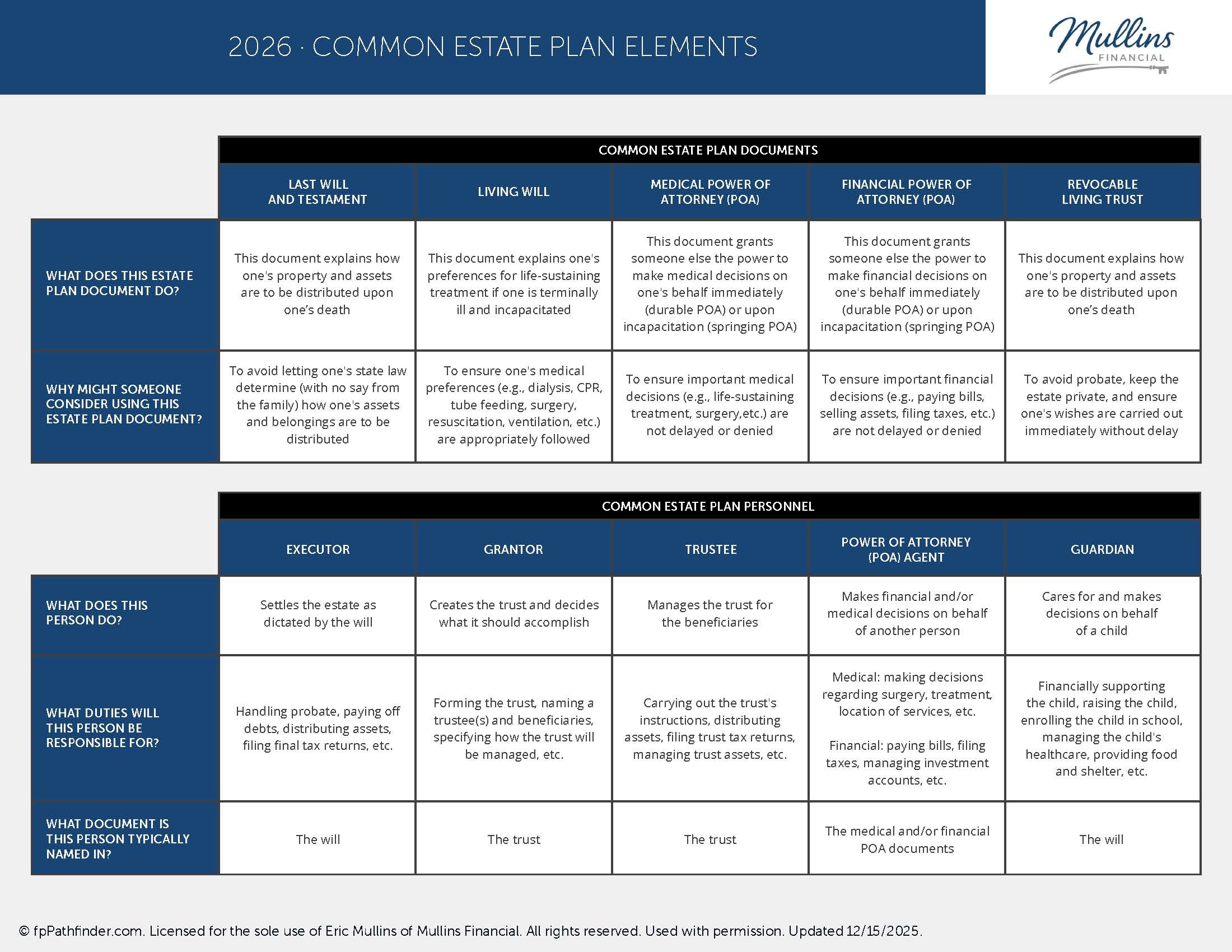
Common Estate Plan Documents Chart
The Four Questions an Estate Plan Should Help Answer
Although every situation is different, a comprehensive estate plan should generally help address four big questions:
Who makes decisions for me if I cannot make them myself?
Who manages my financial affairs if I become incapacitated?
Who is responsible for settling my affairs after I die?
Where do my assets ultimately go?
Different documents answer different parts of those questions.
That distinction matters because your will, for example, generally does not give someone authority to manage your finances while you are alive. Likewise, naming someone as your financial power of attorney does not make that person the individual responsible for settling your estate after death.
Let's break down the major pieces.
1. Last Will and Testament
A last will and testament provides instructions for property that passes through your estate at death.
Among other things, a will may identify:
Who should receive certain property
Who should serve as your personal representative
Who you would like to serve as guardian for minor children
How remaining estate assets should be distributed
Whether certain assets should be held in a trust for beneficiaries
Minnesota law does not require everyone to have a will, but without one, Minnesota's intestacy laws generally determine how probate property is distributed.
One of the biggest misconceptions about a will
Your will does not necessarily control everything you own.
Many assets can transfer outside of your will.
Examples may include:
401(k), 403(b), and 457(b) accounts
Traditional and Roth IRAs
Life insurance
Annuities
Transfer-on-death accounts
Payable-on-death accounts
Certain jointly owned property
Assets titled in a trust
Pension survivor benefits
These assets may instead transfer according to a beneficiary designation, ownership arrangement, retirement-plan rules, or trust instructions.
That is why I frequently tell clients that estate planning is partly a legal-document exercise and partly a financial-account coordination exercise.
Both pieces need to work together.
2. Financial Power of Attorney
A financial power of attorney allows another person - your agent or attorney-in-fac - to handle financial matters on your behalf.
Depending on how the document is written, that authority could include tasks such as:
Paying bills
Managing bank accounts
Handling financial transactions
Working with investment accounts
Signing certain documents
Managing property
Handling tax matters
A durable financial power of attorney can be designed to remain effective if you later become incapacitated. Minnesota's Attorney General describes a power of attorney as a document authorizing another person to act on your behalf and notes that the amount of authority granted depends on the document.
Why this document can matter before death
Imagine a retired public employee suffers a stroke and is temporarily unable to manage household finances.
The immediate questions may have nothing to do with inheritance.
Someone may need to:
Pay the mortgage
Access checking accounts
Handle insurance paperwork
Coordinate bills
Deal with investment accounts
Communicate with financial institutions
A properly structured financial power of attorney can help identify who has the authority to step into that role.
Importantly, the authority granted under a power of attorney does not simply turn that person into the individual who manages your estate after you die. At death, responsibilities generally shift to the personal representative, trustee, beneficiaries, or others depending on how the assets are structured.
3. Health Care Directive
You may hear terms such as living will, medical power of attorney, advance directive, and health care directive used in estate-planning conversations.
In Minnesota, a health care directive can communicate your wishes regarding medical treatment and allow you to appoint a health care agent to make decisions when you cannot make them yourself.
The Minnesota Attorney General explains that a Minnesota health care directive can include both an appointment of a health care agent and instructions regarding your health care wishes.
That makes it particularly important to distinguish the health care role from your financial power of attorney.
Your health care agent may need to answer questions such as:
What treatments would you want?
What treatments would you not want?
How should life-sustaining treatment be handled?
Who should communicate with doctors?
What are your preferences regarding comfort and end-of-life care?
Your financial agent and health care agent can sometimes be the same individual, but they do not have to be.
The important question is whether each person is well suited for the responsibility you are giving them.
4. Revocable Living Trust
A revocable living trust is another estate-planning tool that may be appropriate in certain situations.
The person establishing the trust may be called the grantor, settlor, or trustor. Property is transferred into the trust and managed by a trustee for the benefit of the trust's beneficiaries.
During your lifetime, you may even serve as your own trustee.
You would typically also name a successor trustee who can take over if you become unable to manage the trust or after your death.
A revocable living trust can provide additional control over how assets are managed and distributed. It may also help assets held by the trust avoid the probate process.
But there is an important catch:
Creating a trust and funding a trust are two different things.
Signing a trust document does not automatically move your house, investment account, or other assets into the trust.
The ownership or beneficiary structure of appropriate assets generally must also be coordinated with the trust.
For example, someone could pay an attorney to prepare an excellent trust document but never retitle the intended assets.
The legal document exists.
But the financial accounts may not be connected to it.
This is one of the areas where coordination between your estate-planning attorney and financial professional can be particularly valuable.
Who Are All the People Named in an Estate Plan?
The documents are only one half of the picture.
The other half is deciding who you trust to carry out your instructions.
And one person does not necessarily need to fill every role.
Personal Representative — Sometimes Called the Executor
Your personal representative is responsible for administering your probate estate after your death.
Responsibilities may include:
Gathering estate property
Paying appropriate debts and expenses
Handling estate administration
Filing required tax returns
Distributing remaining property according to the will and applicable law
Minnesota commonly uses the term personal representative, although many people are more familiar with the word executor.
When considering whom to name, ask:
Is this person organized, responsible, trustworthy, and capable of handling administrative details during what may already be an emotional time?
Grantor or Settlor
The grantor is generally the person who creates and contributes property to a trust.
This is different from the trustee.
For example, Bob and Sally might establish the Bob and Sally Family Revocable Trust.
Bob and Sally are the grantors.
They may also initially serve as trustees.
After their deaths or incapacity, a successor trustee they selected could take over management of the trust.
Trustee
The trustee manages assets held by the trust according to the terms of the trust document.
That may include:
Managing investments
Maintaining records
Paying expenses
Filing tax returns
Making distributions to beneficiaries
Following restrictions or instructions established in the trust
The right person for this role may depend heavily on how complicated the trust is.
Managing assets for a responsible 50-year-old beneficiary is very different from administering a long-term trust for young grandchildren or a beneficiary who may need ongoing assistance.
Financial Power of Attorney Agent
Your financial POA agent is the person authorized to handle the financial responsibilities granted under your power-of-attorney document.
Consider both trust and competence when selecting this person.
Someone can be a wonderful family member and still not be the best person to manage complicated finances.
It can also be helpful to name an alternate in case your first choice is unavailable.
Health Care Agent
Your health care agent speaks for you regarding medical decisions when the conditions in your health care directive are met and you are unable to make those decisions yourself.
This can be a difficult role.
Consider choosing someone who:
Understands your values
Is willing to carry out your wishes
Can communicate clearly with medical professionals
Can remain calm under stress
Will advocate for what you want, even when other family members disagree
Then actually have the conversation with them.
A person's name on a document is more useful when that person understands why you selected them and what matters to you.
Guardian for Minor Children
Parents with minor children may also use their estate plan to nominate who they would like to care for their children if both parents die.
This is one reason younger families should not assume estate planning is only for retirees or people with significant wealth.
The guardian role may involve day-to-day care and decision-making for a child.
A separate trustee can potentially be responsible for managing inherited financial assets.
Those do not necessarily need to be the same person.
Think of Estate Planning as a Relay Race
One way to understand these roles is to think about estate planning as a relay race.
At different points in your life, responsibility may pass from one person to another.
While you are healthy and capable
You generally remain in control of your finances and health care decisions.
If you become incapacitated
Depending on your documents and circumstances:
Your financial POA agent may assist with financial matters.
Your health care agent may assist with medical decisions.
A successor trustee may take over management of trust property.
After death
Different responsibilities shift again:
The personal representative administers the probate estate.
A trustee continues managing trust property.
Named beneficiaries may receive retirement accounts and insurance proceeds.
Pension survivor benefits may continue according to the retirement election already made.
Understanding who takes over, what they control, and when their authority begins is just as important as knowing who ultimately inherits your assets.
Why This Gets More Important for Public Employees and Retirees
Estate planning can become especially interesting for Minnesota public employees because a significant part of your financial life may exist outside a traditional investment portfolio.
Consider a retired public employee who has:
A PERA, TRA, or MSRS pension
Social Security
A Minnesota Deferred Compensation Plan 457(b)
An IRA
Employer or individually owned life insurance
A home
Bank and investment accounts
Each piece can follow different rules.
Your pension survivor election may determine what income continues to your spouse.
Your 457(b) or IRA may pass according to its beneficiary designation.
Life insurance generally follows its beneficiary form.
Your home may pass through probate, joint ownership, a transfer-on-death arrangement, or a trust depending on how it is structured.
Your will generally governs only the assets that actually become part of your probate estate.
This is why simply asking:
“Do I have a will?”
is not enough.
A more useful question is:
“If something happened to me tomorrow, do I know how each part of my financial life would work?”
A Simple Example: Bob and Sally
Imagine Bob worked for a Minnesota city and receives a PERA pension. Sally worked in the private sector.
Together they have:
Bob's PERA pension
Sally's 401(k)
Two IRAs
A joint investment account
Their home
Life insurance
Bank accounts
They completed estate documents ten years ago.
On the surface, they feel prepared.
But during a retirement review they discover:
One IRA still lists an outdated beneficiary.
They cannot remember the survivor option selected on Bob's pension.
Their financial power of attorney names someone who is no longer able to serve.
Their oldest child was named as an alternate decision-maker at age 20 but is now in a much better position to help.
Their trust was created, but they are unsure which assets were actually transferred into it.
Sally does not know where the signed estate documents are stored.
None of those issues necessarily requires Bob and Sally to redesign their entire estate plan.
But each deserves attention.
That is what a coordinated estate-plan review is designed to uncover.
Five Questions to Ask About Your Own Plan
As you look at the graphic above, ask yourself:
1. Do I know which estate-planning documents I currently have?
Not which ones you think you signed 15 years ago.
Could you actually locate the current copies?
2. Do I know who is named in each important role?
Identify your:
Personal representative
Financial POA agent
Health care agent
Trustee and successor trustee
Guardian nominations
Primary beneficiaries
Contingent beneficiaries
3. Are those still the right people?
People age.
Relationships change.
People move.
Health changes.
Someone who was an appropriate choice ten or fifteen years ago may no longer be the best choice today.
4. Do my accounts and estate documents tell the same story?
Compare your documents with your:
Pension elections
457(b) and 403(b) accounts
401(k)s
IRAs
Life insurance
Annuities
Investment accounts
Bank accounts
Real estate
Look for inconsistencies.
5. Does someone else know where everything is?
A plan becomes much more useful when the people responsible for carrying it out can actually find what they need.
Estate Planning Is the “L” in the CLARITY Retirement Method™
At Mullins Financial, Legacy & Estate Planning represents the L in our CLARITY Retirement Method™.
Our role is not to replace an estate-planning attorney or provide legal advice.
Instead, we help bring the financial pieces together.
That may include helping clients:
Organize their assets
Review beneficiary designations
Understand how pension survivor decisions affect a spouse
Identify accounts that may need additional attention
Review how life insurance fits into the survivor plan
Consider the income needs of a surviving spouse
Organize questions for an estate-planning attorney
Review whether completed estate documents are reflected in the financial accounts
Through our relationship with Wealth.com, clients can also access estate-planning resources designed to help make the document-creation process more organized and approachable, with attorney resources available when individualized legal guidance is needed.
Estate planning shouldn't exist in isolation from retirement planning.
Your pension, investments, taxes, insurance, beneficiaries, and legal documents are all parts of the same financial life.
What To Do Next?
If you haven't already, start with our Estate Plan Review Checklist:
Read: Is It Time to Update Your Estate Plan?
Then use the graphic above to identify the documents you already have and the people currently named to serve.
You don't need to answer every legal question yourself.
Instead, start by determining:
- What do I have?
- Who is responsible?
- Does it still reflect what I want?
- And does it coordinate with the rest of my financial plan?
Those four questions can go a long way toward turning an estate plan from a collection of documents into a plan your family can actually use.
Ready to bring your estate plan into the bigger retirement picture?
Schedule a 20-Minute Retirement CLARITY Call
This material is provided for general informational and educational purposes and is not intended as legal or tax advice. Mullins Financial does not provide legal advice. Estate-planning laws and individual circumstances vary. Consult a qualified estate-planning attorney and tax professional regarding your specific situation.