


An estate plan is an important part of a complete financial plan. It helps communicate your wishes, identifies the people you trust to act on your behalf, and provides direction for your family during difficult circumstances.
Unfortunately, estate planning is also one of those important tasks that can be easy to put off.
Maybe you have been meaning to create an estate plan for years.
Perhaps you completed your documents a long time ago but are no longer sure what they say.
Your family, finances, or wishes may have changed since your documents were signed.
Or you may simply want reassurance that everything still works the way you intend.
Whatever your situation, creating an estate plan is only the first step. Your documents, beneficiary designations, account ownership, and financial plan should also be reviewed periodically to make sure they remain aligned.
What Does an Estate Plan Accomplish?
Estate planning is about more than determining who receives your assets after your death. A thoughtful plan may also address:
- Who can manage your financial affairs if you become unable to do so
- Who can make health care decisions on your behalf
- How and when beneficiaries receive an inheritance
- Who should care for minor children
- How retirement accounts, insurance policies, and jointly owned assets transfer
- Who will be responsible for carrying out your instructions
- Whether a trust may be appropriate for your family
- How your wishes will be communicated to the people who need to know
In Minnesota, a will can direct how property passing through your estate should be distributed. A financial power of attorney allows another person to act on your behalf in financial matters, while a health care directive can communicate your medical wishes and identify someone to make health care decisions when you cannot.
The documents you need will depend on your circumstances, which is why estate planning should involve an estate planning attorney who can provide legal advice specific to your situation.
Your Will Is Only One Part of the Plan
Many people think that once they have signed a will, their estate planning is finished.
However, not every asset is necessarily controlled by your will.
Retirement accounts, IRAs, life insurance policies, transfer-on-death accounts, payable-on-death accounts, and certain jointly owned assets may pass according to their account registrations or beneficiary designations.
That means your beneficiary forms can be just as important as the instructions contained in your estate documents.
Retirement benefits are generally paid according to the beneficiary designation and the terms of the retirement plan. Different distribution rules may also apply depending on whether the beneficiary is a spouse, another individual, a trust, an estate, or a charity.
A coordinated estate plan should therefore consider both your legal documents and the way your financial accounts are structured.
When Should You Review Your Estate Plan?
An estate plan should not be treated as something you complete once and then forget.
A review may be especially important following:
- A marriage, divorce, or remarriage
- The birth or adoption of a child or grandchild
- The death or incapacity of a spouse, beneficiary, trustee, executor, or agent
- A significant change in your assets or income
- The purchase or sale of a home, business, or other major asset
- A move to another state
- Retirement
- A change in your charitable intentions
- A change in your relationship with a beneficiary or decision-maker
- A significant change in tax or estate-planning laws
Marriage, divorce, the birth of a child, and the death of a spouse can also be important reasons to revisit retirement-plan beneficiary designations.
Even when there has not been a major life event, periodically reviewing your documents can help you remember what they say and confirm that the people you selected are still willing and able to serve.
Questions to Ask During an Estate Plan Review
As you review your estate plan, consider the following questions.
Are your beneficiaries still correct?
Review the primary and contingent beneficiaries listed on your:
- Employer retirement plans
- 401(k), 403(b), and 457(b) accounts
- Traditional and Roth IRAs
- Pension or survivor benefits
- Life insurance policies
- Annuities
- Health savings accounts
- Transfer-on-death and payable-on-death accounts
Do not assume that changing your will automatically changes these account-level designations.
Are the right people named to help?
Your plan may identify several different people, including:
- A personal representative or executor
- A financial power of attorney
- A health care agent
- A trustee
- A guardian for minor children
- Backup or successor decision-makers
Consider whether each person remains appropriate for the role. Also ask whether you have named alternatives in case your first choice is unable or unwilling to serve.
Do your documents reflect your current family?
Families change over time. Your plan may need to account for a new marriage, children from a prior relationship, grandchildren, aging parents, a beneficiary with a disability, or someone who may not be prepared to manage an inheritance.
In some situations, leaving assets outright may not provide the control or protection you want. An estate planning attorney can help determine whether a trust or another arrangement may be appropriate.
Do your documents work with your financial accounts?
Your attorney may have created a carefully structured plan, but it may not work as intended if accounts were never retitled, a trust was never funded, or beneficiary designations conflict with the documents.
Your legal and financial professionals should understand how your accounts are owned and how they are expected to transfer.
Can your family locate the information they will need?
A well-written estate plan is less helpful if no one knows where the documents are stored.
At least one trusted person should know how to locate:
- Your estate documents
- Contact information for your attorney, financial professional, and tax professional
- A current list of financial accounts and insurance policies
- Digital account information and instructions
- Important property records
- Funeral or memorial preferences
- Keys, safe-deposit-box information, and other essential records
Avoid placing the only copy of critical instructions somewhere your family may not be able to access.
Estate Planning for Public Service Professionals
Public employees and retirees may have additional estate-planning decisions involving pensions, survivor benefits, deferred compensation accounts, 403(b) plans, 457(b) plans, and retiree insurance.
For example, the survivor option selected when beginning a pension may determine how much income continues to a spouse after the retiree’s death. That decision may be permanent once retirement begins.
Your pension election, life insurance, retirement accounts, Social Security benefits, and estate documents should be considered together rather than as separate decisions.
This coordination can help answer questions such as:
- How much income would continue to a surviving spouse?
- Would the survivor have enough accessible savings?
- Are pension and retirement-plan beneficiaries current?
- Would life insurance be needed to replace lost pension income?
- Should retirement assets pass directly to a spouse or through a trust?
- Who can manage financial accounts if incapacity occurs?
- Does the estate plan reflect the choices made on pension and benefit forms?
These are financial-planning considerations that can then be coordinated with the legal recommendations provided by your estate planning attorney.
Download the Estate Plan Review Checklist
To help you prepare for a conversation with your attorney and financial professional, we have a checklist outlining 19 important considerations for updating an estate plan.
The checklist can help you review your documents, beneficiaries, decision-makers, account ownership, family circumstances, and other areas that may require attention.
Download: What Issues Should I Consider Before I Update My Estate Plan?
As you go through the checklist, does anything stand out?
Maybe you have known for years that you need to complete your documents. Perhaps you already have an estate plan but cannot remember what it says. Or your legal documents may be current, but your financial accounts and beneficiary designations have not been reviewed recently.
You do not need to solve every issue on your own. The first step is identifying what may need attention.
Bring Your Estate Plan Into the Bigger Financial Picture
At Mullins Financial, estate and legacy planning is the “L” in the CLARITY Retirement Method™.
We help clients organize their financial information, review how assets and beneficiary designations fit together, identify questions to discuss with an estate planning attorney, and consider how estate decisions affect the surviving spouse and the broader retirement plan.
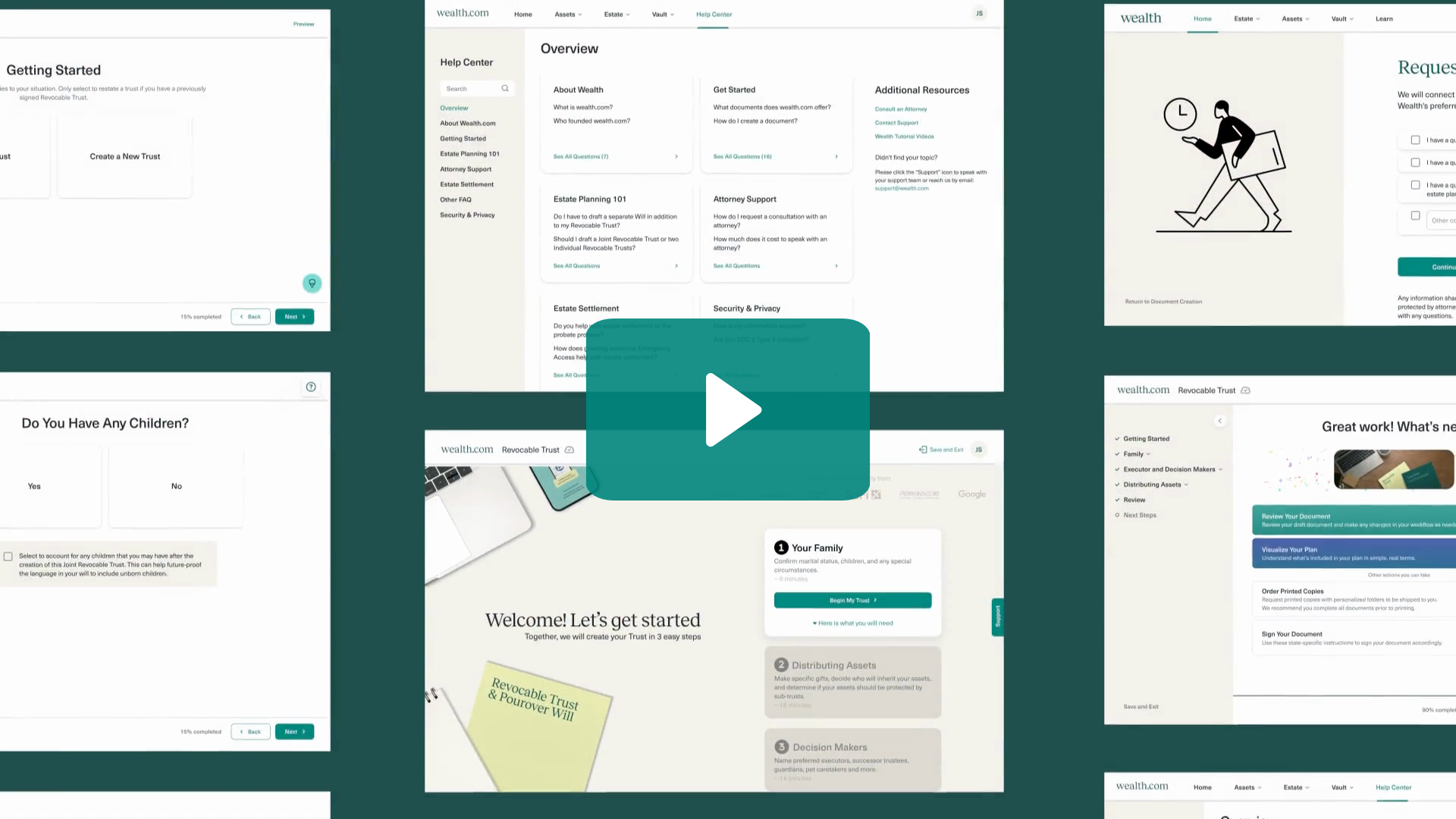
Through our relationship with Wealth.com, clients can also access a guided estate-planning platform that helps them create personalized, state-specific estate documents. Depending on their needs, these documents may include:
- A last will and testament
- A revocable living trust and pour-over will
- A financial power of attorney
- An advance health care directive
- Guardianship nominations for minor children
The platform guides clients through a series of questions about their family, assets, beneficiaries, decision-makers, and wishes. It then generates documents designed to be legally valid once properly executed for the laws and requirements of the client’s state. Clients also receive guidance about the steps needed to put the documents into effect, including applicable signing, witnessing, and notarization requirements.
This allows us to help clients move beyond simply identifying that they need an estate plan. We can provide a clearer and more convenient path toward completing one.
Mullins Financial does not provide legal advice, and Eric does not personally draft or select the provisions within a client’s legal documents. The Wealth.com process is client-directed, with access to estate-planning resources and attorney consultations when additional legal guidance is needed.
We also help connect the completed legal documents to the rest of the financial plan by reviewing areas such as:
- Beneficiary designations
- Retirement accounts and deferred compensation plans
- Pension survivor elections
- Life insurance
- Account ownership
- Trust funding considerations
- The income needs of a surviving spouse
- The people responsible for carrying out the plan
Estate planning is easy to leave on the to-do list because it can feel complicated, expensive, or difficult to begin. Through the CLARITY Retirement Method™ and our relationship with Wealth.com, our goal is to make the process more organized and approachable—so “complete the estate plan” can become something you finally check off the list.
Whether you are creating your first estate plan, replacing outdated documents, or confirming that an existing plan still reflects your wishes, we can help you take the next step and connect it to your overall financial life.
Want to learn more about Wealth.com? Watch this 2-minute video below!
Schedule a 20-Minute Retirement CLARITY Call
We can help you identify the financial questions that should be considered and determine which issues may need to be reviewed with your estate planning attorney.
This material is provided for general educational purposes and is not intended as legal or tax advice. Estate planning laws and individual circumstances vary. Consult a qualified estate planning attorney and tax professional regarding your specific situation.